

THE ANTI-ENSH*TTIFICATION FIELD MANUAL FOR INDIE AUTHORS By Tracy Cooper-Posey
Now available for pre-order. Releases September 10, 2026
Non-Fiction for Writers
Productive Indie 3.0
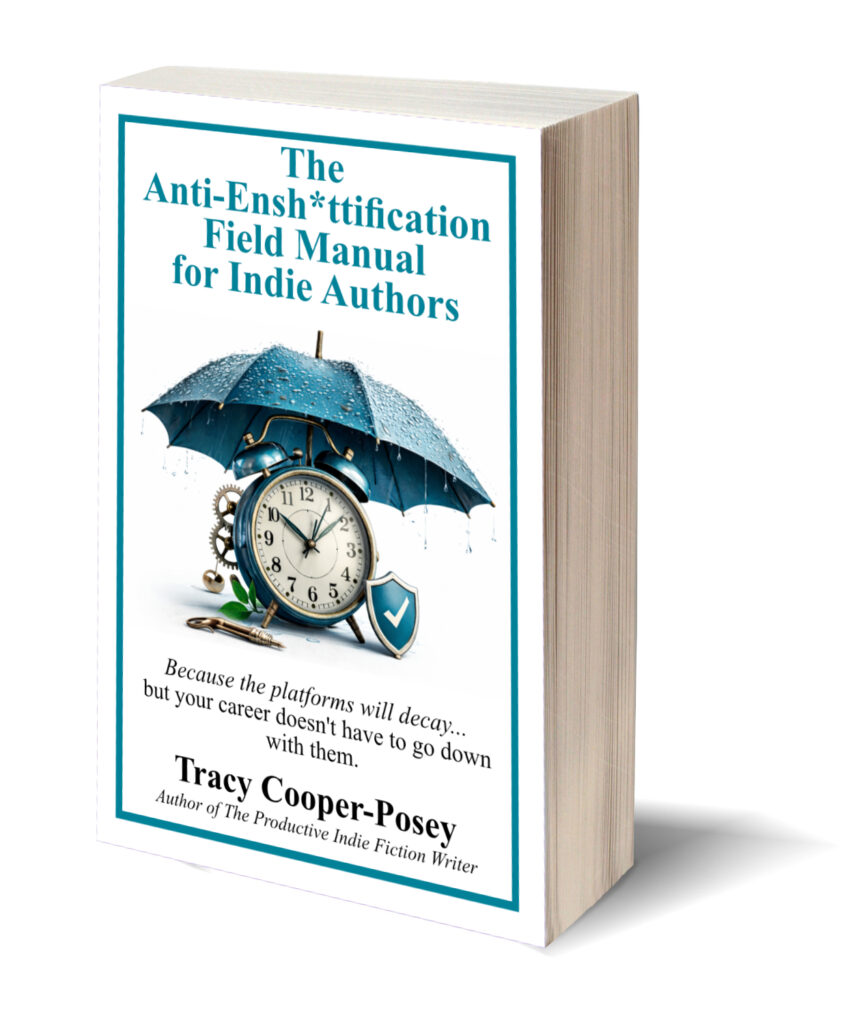
Because the platforms will decay…but your career doesn’t have to go down with them.
| Read the reviews | Read an excerpt |
The internet isn’t what it used to be. Platforms that once seemed stable are now throttling your reach. Retailers are cutting services. Social media is a mess. “Creator tools” are becoming pay-to-play traps. And everyone keeps telling you to hustle harder to keep up.
No. You don’t need to hustle harder.
You need a business that doesn’t collapse every time a corporation sneezes.
This is that business.
Drawing on lived experience, including years derailed by cancer, family crises, burnout, and constant industry upheavals, Tracy Cooper-Posey lays out a calm, practical, deeply human manual for building an author career that survives anything: platform decay, bad years, sickness, burnout, and the slow rot of the modern internet.
Inside, you’ll learn how to:
- recognize ensh*ttification early,
- build reader funnels that make social media optional,
- cultivate loyalty loops that last for years,
- stay sustainable when life blindsides you,
- build systems that are light, flexible, and adaptable,
- and protect the one part of your business corporations can’t enshittify: your relationship with your readers.
This isn’t a “grow fast” book. It’s a “stay free” book. If you want a career built on stability, autonomy, human connection, and long-term resilience, start here.
This title is part of the Productive Indie Fiction Writer series:
Prices shown in Canadian dollars (CAD). Switch currency in the header if needed.
.
.
BUY FROM STORIES RULE PRESS


Buy from SRP and earn purchase points!
Electronic book, compatible with all reading devices. Book can be read on all devices and apps. [More info]
BUY FROM YOUR FAVOURITE BOOKSELLER

Includes print editions

Reviews
Submit your review | |
| Bookmark on Bookbub | Bookmark on Goodreads |

Electronic book, compatible with all reading devices. Book can be read on all devices and apps. [More info]
ePub or Mobi format files provided.
You will receive an email from BookFunnel with the download links once your transaction has been processed. (For pre-orders, the download link will be emailed to you on the release date.)
BookFunnel will assist with any download issues. Click the Need Help? link at the top right of the download page.
| Continue browsing books | Jump back to top of page |
Excerpt
Introduction:
Why This Manual Exists
Every week feels like a new crisis. Amazon rolled out a major algorithm overhaul and indie authors are reporting sudden visibility issues and non-responsive rankings. Audible revamped its royalty model, only for many creators to find their payouts fell anyway. Subscriptions, exclusivity clauses, algorithm changes, climbing advertising costs, disappearing organic reach. Invisible visibility. They all feel distinct, but they’re symptoms of the same disease.
That disease is enshittification, the steady decay of platforms as they turn against the people who made them successful. First, they court us. Then, they exploit us. Finally, they trap us. Every headline, every forum uproar, every what now? moment you’ve seen over the past decade traces back to that single process.
Once upon a time, the internet was a wild, hopeful place. You could hang out your shingle, build a list, talk to readers, sell books, and make a living without asking anyone’s permission. It was supposed to level the playing field: you could reach readers directly, keep most of your earnings, and build a business on your own terms.
I started publishing traditionally in 1999, and thirty-five titles later I jumped off that bandwagon when too many wheels fell off. I went fully indie in 2011, lucky enough to catch the wave at its crest. Back then, you could publish anything you wanted, sit back, and watch it sell. The dream worked for a while. Then the platforms began to rot.
Now, every system that once promised to empower creators has quietly flipped the script. You’ve heard the terms: pay to play, rapid release, advertise or die.
The word enshittification, coined by Cory Doctorow, describes this perfectly.
Every digital system starts by serving users, then shifts to serving business customers, and finally exists only to extract value for itself. It’s the inevitable cycle of decay once venture capital and monopoly power take over.
For authors, it looks like this: Amazon changing algorithms overnight, cutting KU payouts or changing them altogether. Facebook silencing organic reach. TikTok’s rules mutating daily. Even smaller tools—the friendly little productivity apps we once trusted, even something as simple as your task manager—eventually get acquired, over-monetized, and wrecked.
Indie authors live at the mercy of these systems. We rely on them for sales, distribution, reader contact, and even our daily workflows. When they collapse or mutate, our livelihoods take the hit first.
This book isn’t a rant about how awful that is. It’s a field manual for surviving it. It’s written for the working creatives who still want to earn, write, and connect even as the digital foundations crumble underfoot. It’s about taking back control: building structures that last longer than any one platform. You can’t stop enshittification, but you can make yourself far less dependent on the systems that are enshittified.
Who I Am, and Why I’m Writing This
I’ve been an independent author and publisher since 2011. I’ve built systems, watched them collapse, and rebuilt from the rubble more times than I can count. I’ve seen the industry reinvent itself in cycles of excitement, panic, and consolidation.
This isn’t theory. I’ve lived through every iteration of the “next big thing” that was supposed to save authors: blogs, social media, KU, BookTok, subscription models, crowdfunding, AI, and whatever comes next. Each new product or strategy promised liberation and delivered a different kind of dependence.
But what really forced me to finally write this book was that very simple thing I mentioned, above. My task manager, that I have been using for well over ten years and rely on to keep my business on the rails, has steadily grown from a simple task manager to a collaboration tool, to a business project manager, with calendar functions, Kanban boards and now…AI. Two days ago, I got an email from them informing me that my business plan was being phased out and I would be transferred to a new plan that included–aren’t you lucky?–their new AI features (that I didn’t want), all for a monthly sum that was more than three times what I was currently paying.
I spent a day looking for a new task manager, and transferring over to it, so that my very small team of two family members and I could keep producing books.
I was annoyed. But here’s the thing: I wasn’t annoyed enough. Because I’ve got used to this. Because it’s the way things are.
I blew off ten years of loyalty, and promoting that company endlessly on my blog, The Productive Indie Fiction Writer. Given the price hike, I didn’t hesitate.
Even when I re-read the email announcing the price hike, I didn’t hiss in annoyance. Instead, in the back of my mind was a silent so they’ve enshittified now.
At a personal level, I’ve also tracked this same rotting away of a good corporation.
The internet provider we’ve been using for nearly thirty year was recently bought out (a very typical Uh oh! warning sign you’ll get to hear about soon) by a bigger corporation. At the time they announced it, I told my husband: “That’s it. The service will nose-dive now.”
And right on cue, three months later, our once rock-solid, reliable internet connection started to fritz on a daily basis…until we upgraded to a new, more expensive service and modem. Customer service is now non-existent. You have to use AI chat bot to get anything done.
Enshittification happens everywhere but, as I’ve said, us indie authors are dependent upon these rotting systems.
What you’ll find here are not complaints, but patterns. Once you recognize how platforms rot, you can plan around it. You can make strategic, antifragile decisions instead of reacting in panic every time a platform changes its rules.
Who This Book is For
This book is for indie authors; people running a business around their own intellectual property. Working writers who publish their own work, manage their own infrastructure, and know that their name is their brand.
If you’re a hybrid or traditionally published author, you’re welcome here, but know this: your playing field is tilted steeper. You’re building on someone else’s turf. We’ll be talking about how to work inside broken systems without depending on them in various places throughout the book, but the short version is this: you’ll need to build your own independent foundation, too. The world that once protected you is rotting faster than ours.
If you’re another kind of creative—artist, musician, game designer, whatever—you’ll find some value here. The principles of independence and resilience translate well. But this field manual was written for authors first and foremost. Every strategy, tool, and system in these pages was tested inside an indie publishing business, not a generic creative enterprise.
Let’s also be clear about what this book isn’t.
- It’s not a craft book. We’re not talking story structure, character arcs, or prose polish.
- It’s not a political call-to-arms. We’re not forming a union or storming the gates.
- It’s not a digital-rights essay collection. I’m not here to quote policy papers or debate copyright reform.
- It’s not a social-media how-to. Those tactics are decaying faster than platforms can rename themselves.
- And it’s not a technical manual. If you want app tutorials or AI prompt recipes, you won’t find them here.
This is a field manual—practical, tested, occasionally blunt. It’s about how to stay functional and profitable while the digital systems around us decay. It’s for the solo and micro-press authors who want to keep earning, writing, and connecting even as the rules keep changing.
If that’s you, then welcome. You’re in the right place.
Notes on Time, Decay, Geography, and Scale
Time matters. The half-life of every tool and platform keeps shrinking. What worked a year ago might already be obsolete. This book assumes that change and obsolescence are the default conditions of the modern internet. The goal isn’t to chase the latest fix, but to build a mindset along with habits and systems that survive change.
Decay is normal. Every centralized system eventually starts feeding on its users. That’s not cynicism; it’s observable fact. The moment investors expect endless growth, the rot begins. Understanding that helps you stop taking these betrayals personally. You can’t stop the decay, but you can stop it from hollowing out your business.
Geography shapes perspective. I’m writing this from Canada, where we deal with the same corporate platforms but through a slightly different economic and cultural lens. If you’re somewhere else, adjust what you read here to fit your own terrain—your tax laws, your reader behavior, your local economy. The principles stay the same even when the map looks different.
Scale matters, too. This field manual is written from the perspective of solo authors and very small indie teams—the people running lean operations, doing most things themselves, and building sustainable creative businesses one system at a time. Larger operations will recognize many of the same pressures, but their challenges tend to be different. The examples here come from ground level, because that’s where most indies live and where flexibility matters most.
If you’re further along, consider this a reminder of where your strength started: in independence, adaptability, and close connection with your readers.
About That Asterisk
You might have noticed the asterisk in the title. It’s deliberate. It’s an act of resistance.
When you write about “enshittification,” algorithms and automated censors throw a fit. Search engines bury you. Ad networks blacklist you. So you adapt. The asterisk is a workaround, a reminder that creative people have always found ways to speak truth even in hostile systems.
That’s the entire philosophy of this book in miniature: don’t waste time begging broken systems to behave. Learn to design around them.
How to Use This Book
You can read straight through if you want the full context, or you can jump directly to the practical chapters when you’re in survival mode. Each section stands alone, but together they form a framework for creative resilience.
This book is divided into five parts, each addressing a different layer of independence.
Part I – The Terrain: Understanding Enshittification
Lays the groundwork. It explains how the rot began, why it accelerates, and how it manifests for indie authors. You’ll see how burnout isn’t a personal failure but a systemic feature—and how recognizing that changes everything.
Part II – The Mindset: Building Your Author Armor
Covers the mental, ethical, and professional foundations of surviving decay. It’s about detaching your ego from platforms, thinking like a business, and adopting a code of autonomy and realism that keeps you sane while everything else shifts.
Part III – The Systems: Designing an Independent Infrastructure
The practical heart of the book. You’ll learn how to build an ecosystem you actually control—your own site, store, mailing list, backups, and workflows. These are the systems that make you antifragile and profitable without relying on monopolies.
Part IV – The Fieldwork: Surviving Day to Day
Takes those principles into the trenches. It’s about daily operations: using platforms tactically, maintaining reader relationships, managing your energy, and rebuilding when life and business fall apart at the same time.
Part V – The Future: Staying Agile When Everything Shifts Again
This section looks ahead and shows you how to, as well. It’s about pattern recognition, adaptability, and collaboration—how to stay alert for the next chokepoint and keep your freedom by making independence a daily practice, not a one-time goal.
_____
Throughout, you’ll find examples, systems, and strategies tested in real indie publishing businesses. None of this is prescriptive. Especially in 2025, no two indie authors run their careers the same way. The industry has fractured into a thousand viable paths. Take what fits, discard what doesn’t. The goal isn’t perfection. The goal is durability.
Use this book like a field manual. Mark what applies to you. Revisit it whenever a platform “update” wipes out your traffic or a new tech fad tries to lure you off your path. The internet will keep breaking. You don’t have to break with it.
Closing Note
Enshittification isn’t the end of the indie author era. It’s just the end of blind trust in the platforms that built it. Independence was always supposed to mean autonomy, not submission to someone else’s algorithm.
The next era belongs to those who build quietly, think long-term, and refuse to be optimized out of existence.
BUY FROM STORIES RULE PRESS