

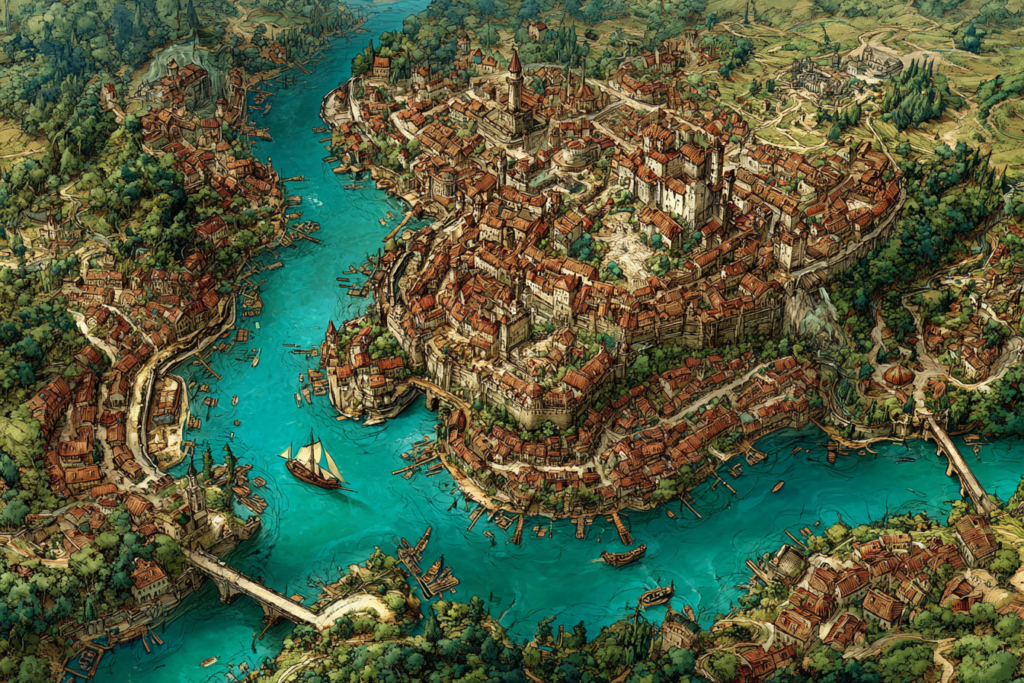
From SRP author Taylen Carver:
I love maps. You already know this if you’ve read my last post about the beautiful lies in fantasy country maps (and the suspicious tectonics around Mordor). But my map obsession doesn’t stop at mountain ranges and river systems. Oh no. I also have opinions about fantasy towns.
Because towns, real ones, don’t just spring up out of nowhere. They grow. They shift. They make sense, even when they look like chaos.
So when I see a fantasy map of a town that clearly didn’t evolve over time, or that seems to have been designed by someone who’s never stepped on an uneven cobblestone in their life, I start twitching. Because here’s the thing: maps tell stories. Even town maps. Especially town maps.
If I can’t study a town map and figure out the broad strokes of its history, it’s not just badly drawn, it’s a missed opportunity.
Where Towns Are Born (And Why It Matters)
Towns don’t just pop into existence because your hero needs a place to buy healing potions.
They’re there for a reason. There’s always a reason. Usually it’s tied to a resource: fertile land, fish-rich rivers, forests for timber, ore to mine. Or it’s a strategic location—like a river crossing or a choke point between two hills. Even the most picturesque coastal village started as a fishing hub or a smuggler’s cove.
And once you know why a town exists, you can start to understand how it grew. The map should reflect that.
The Logic of Old Streets
Old towns are like onions: layered, messy, sometimes pungent.
You can usually find the original seed of the settlement by looking for:
- The old wharf or river dock
- The central well or spring
- The oldest crossroads
Streets radiate from there, often in crooked, nonsensical ways, because they weren’t planned, they were followed. Maybe they started as deer trails, or rutted wagon tracks, or safe paths between farms. If everything’s suspiciously straight and evenly spaced, you’re either in a Roman outpost or someone used a grid overlay in Photoshop.
Bridges Aren’t Cheap
This one gets me every time.
Bridges are expensive. Technically challenging. They don’t just appear because someone thought the symmetry would be nice. If there’s a bridge, there’s a reason for it, and usually a town clings to it because it brings trade, travelers, and opportunity.
A small village with five ornate bridges? Unless they’re elves with an architectural grant, I’m calling nonsense.
Markets, Meeting Halls, and Misplaced Parks
Old towns often have a market square. Sometimes it’s still a market. Sometimes it’s now a roundabout with bad traffic. But it’s almost always near the original center of town.
Public buildings—churches, town halls, temples—cluster nearby. Housing spreads outward from there. And the green, leafy park? That was added later, once someone decided it would be nice to stroll somewhere that didn’t smell like fish.
Real towns are reactive. They get squeezed and reshaped. You can see wars in the way walls forced cramped growth. You can see peace in the boulevards that came later.
Fantasy towns should work the same way.
Roads Don’t Go Around Towns…Until They Do
In small towns, roads go through the center. The inn is there because travelers passed that way. The market square is there because people use the road to get to the market.
Only when the town gets big—and the traffic gets unbearable—do roads start to bypass the chaos. And that bypass is never pretty. It cuts awkwardly through farmland, ruins the local goat path, and creates an eternal debate about whether the good bakery is still “in town” or not.
A ring road in a tiny village? That’s not history. That’s wishful thinking.
A Word on Defenses (Because Yes, I’m Going There)
If the world has seen war—any war—then the town has defensive scars.
Walled cities are tight. Claustrophobic. Buildings grow upward, not outward, because space is limited. Gates become bottlenecks. Markets shift depending on where’s safest. And don’t even get me started on how siege weapons dictate building placement.
So when I see a “fortified” city with open plazas, wide boulevards, and perfectly aligned buildings inside the walls? My suspension of disbelief needs a support beam.
Bonus Rant: Tolkien, We Need to Talk (Again)
Yes, I’m picking on Tolkien. Again. Look, I love the man. I do. But let’s talk about Minas Tirith.
Seven walls stacked like wedding cake sounds impressive—until you realize that each ring is a bottleneck with no fallback plan. The main gate is the weak spot (and guess what? That’s where the orcs go). There’s no real evacuation route. And once the outer ring falls, the rest crumble fast. It sounds good in a book. It looks great in a movie. But as a defensive strategy? Oof.
And then there’s Hobbiton.
It’s adorable. I’d live there. But why is it there? It’s not on a river. It’s not on a trade route. Bag End is somehow a 20-minute walk from the pub, but also “on the edge of town.” There’s no visible reason for its placement except “it looks pretty.” Which, okay, fair. But don’t ask me to believe it evolved that way naturally.
What Good Maps Do
A good map tells a story.
It whispers the town’s origin, its struggles, its priorities. It shows where the oldest buildings stand, where the town outgrew itself, where the past still shapes the present.
Even if you never consciously think about it, you feel it when a map works. And when it doesn’t? You feel that, too.
So the next time you open a fantasy book and find a map of a town, take a moment. Follow the roads. Trace the river. Ask yourself: where did this place begin? What forced it to grow this way?
Because if the map can’t answer that, then the town doesn’t feel real. And in fantasy, that’s what matters most.

Taylen Carver
SRP Fantasy Author
Browse Taylen’s books here.