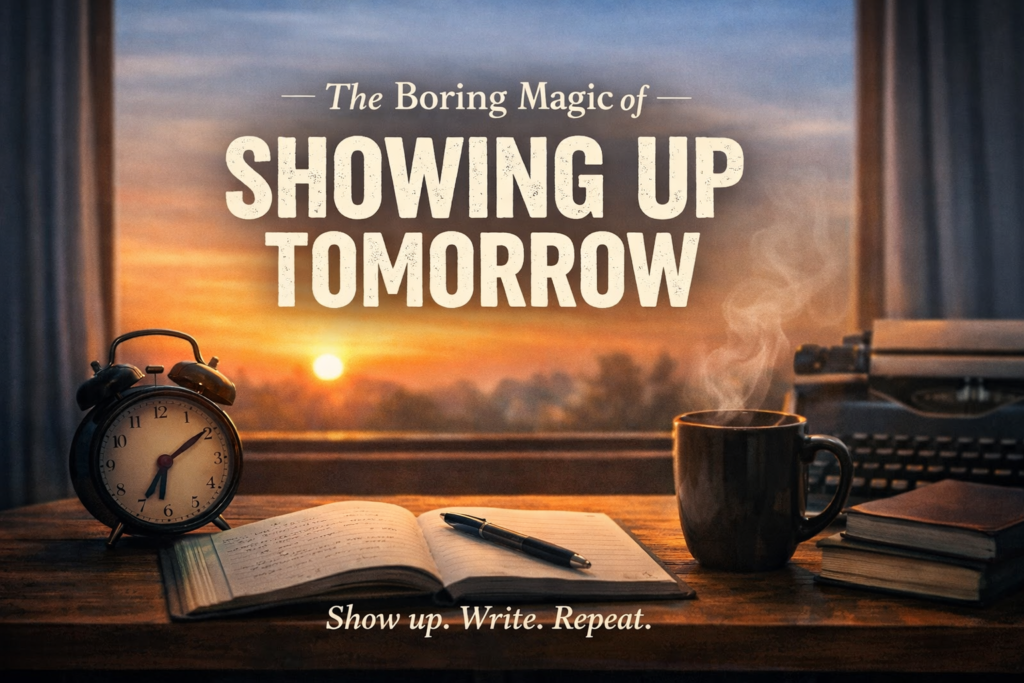
The Boring Magic of Showing Up Tomorrow
The voice that breaks your writing streak doesn’t show up on a bad day.
It shows up after a good one—and tells you to take tomorrow off.
The voice that breaks your writing streak doesn’t show up on a bad day.
It shows up after a good one—and tells you to take tomorrow off.
Struggling to reach flow when you write? It might not be a discipline problem. Flow isn’t just about focus—it’s about whether your brain trusts that everything else is handled. If your mind is still tracking loose ends, unfinished tasks, or “don’t forget this” thoughts, it won’t let go. And without that mental quiet, true immersion in your story stays just out of reach.
We all know downtime matters — but most of us don’t actually build it into our week. After a weekend of enforced “no work, just play,” I relearned the surprising truth: downtime isn’t a luxury, it’s a creative strategy. Even ten-minute breaks can reboot your energy and make you want to work harder. Here’s why you need micro-downtime — and how to make it part of your indie life without guilt.
Juggling multiple pen names, a production pipeline, and the occasional bout of procrastination takes more than just caffeine and stubbornness—though those help. In this post, I break down exactly how I manage my writing and publishing schedule, from rotating pen names to keeping six+ books in postproduction at once. I also explain why I never write more than one book at a time and how I use a 300-step checklist to keep my head (mostly) attached.
I thought I was stuck at 1,200 to 1,300 words per hour because I had been for years. But I wasn’t. I was just telling myself I was. This month, I’ve finished one book, written another in nine days, and started plotting a third—all while juggling a demanding side gig. If you think you can’t write faster, maybe it’s time to stop believing that.
After my fourth serious trial, I’m calling it: for me, dictation is dead—at least for now. The modest bump in words per hour just doesn’t outweigh the tech friction, location lock-in, and editing overhead. If dictation plus clean-up time gets you more net words than typing, go for it. But if you’re already a clean, fast typist, the numbers might tell you to stick with your keyboard.
“At its heart, this book offers a liberating proposal: don’t play the game as it’s currently defined. Walk away from algorithm worship, punishing release schedules, and the grind of selling at 99 cents to churn-hungry subscription readers. Instead, write what you want to write, at the pace that suits you, and charge a fair price for your work.”
I’ve spent the last couple of posts being pretty firm about the importance of doing the work. In Hauling the Bricks and The Indie Author’s Scam Survival Guide, we talked about how there’s no magic shortcut—just putting in the effort, day after day, is what gets you there.
This site is dedicated to productivity. Writing productivity, to be specific. There are hundreds of hints, tips, tricks, and hacks on PIFW to help you write more, write faster, and write better.
Every system has its core principles, and managing your email is no different. At the heart of email organization lies a deceptively simple rule: Delete or Filter.