

From SRP author Cameron Cooper:
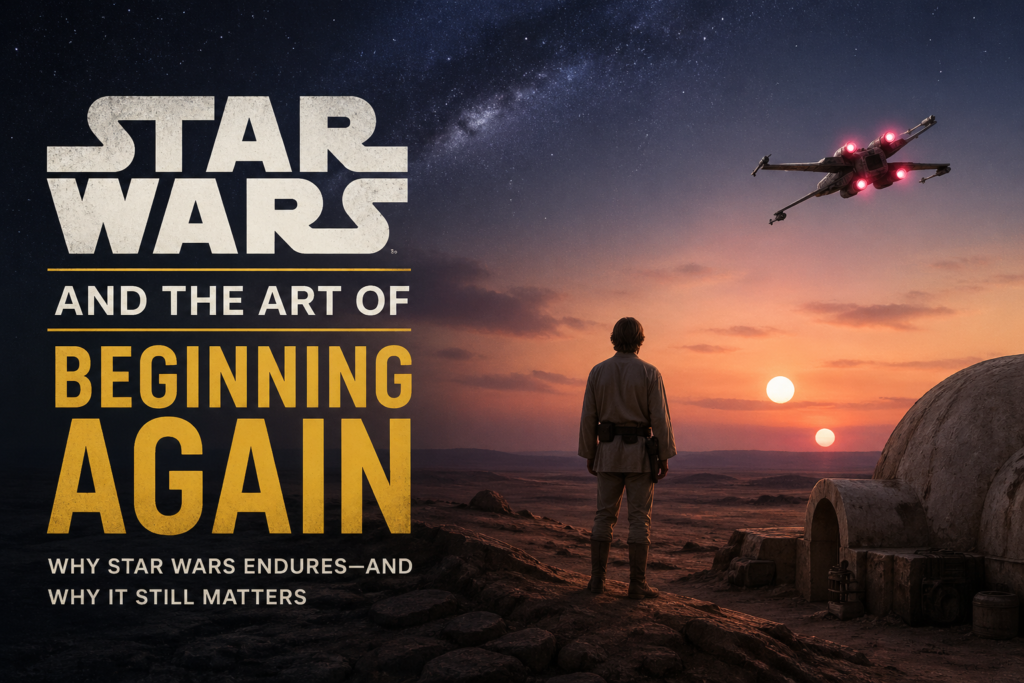
Monday, May 4th is Star Wars Day—May the Fourth Be With You. Lesser known, but impossible to resist, is May 5th: Revenge of the Fifth.
I really have no idea why Star Wars continues to hang in there.
It’s now a doyen of the global science fiction community, with hundreds of books and thousands of hours of spin-off films and television. When the original Star Wars arrived, I was barely a teenager, and it was life-changing. I wrote an unofficial sequel. My English teacher caught me writing in class, read some of it, and told me to write something original.
So I did.
I’ve been writing, on and off, ever since. In 2015, it became my full-time work.
So yes—Star Wars had a direct hand in shaping my life. It locked in my preference for science fiction as a storytelling form. Fantasy runs close behind, but it’s still a half-step back.
When Stars Wars was first released, nothing like it had been seen before. The film was a runaway success, and arguably one of the last true box-office phenomena before home video began to change how audiences consumed stories. The first film I ever owned on VHS was Star Wars.
The roots of the phenomenon are easy enough to understand.
What’s harder to explain is why it continues to linger, even after some very uneven years. The franchise still produces strong work when it chooses to—early seasons of The Mandalorian were excellent. I loved Andor. But those feel like exceptions rather than the rule.
Part of the answer may be generational. Star Wars was built for teenagers and young adults—and I was exactly that when it arrived. I’m not anymore. My tastes have evolved. I want more complexity, more nuance, more risk in storytelling.
Star Wars, by and large, hasn’t evolved in the same way. My kids love it. I expect their kids will too.
So the audience renews itself, even as older viewers quietly drift away. Which still doesn’t quite explain how the franchise continues not just to survive, but to expand.
A Story That Outgrew Its Creators
Maybe the answer is simpler than it looks.
Star Wars no longer belongs to its creators. It doesn’t even belong to George Lucas. It has slipped its moorings and become something else—a shared mythology. Not mythology in the ancient sense, but in the modern one: a set of characters, images, and narrative patterns that people return to, reshape, and pass along.
It doesn’t need to evolve in sophisticated ways because that’s not its function. It needs to be recognizable. It needs to be accessible. And, most importantly, it needs to be there—waiting for the next generation to discover it at exactly the right moment in their lives.
That was true for me. It’s true for my kids. And that may be the real reason Star Wars endures. Not because it keeps getting better.
But because it keeps beginning again.
____
Are you planning on doing anything Star-Wars-y on Monday?
.

Cameron Cooper
SRP Author
Check Cam’s books here on Stories Rule Press.