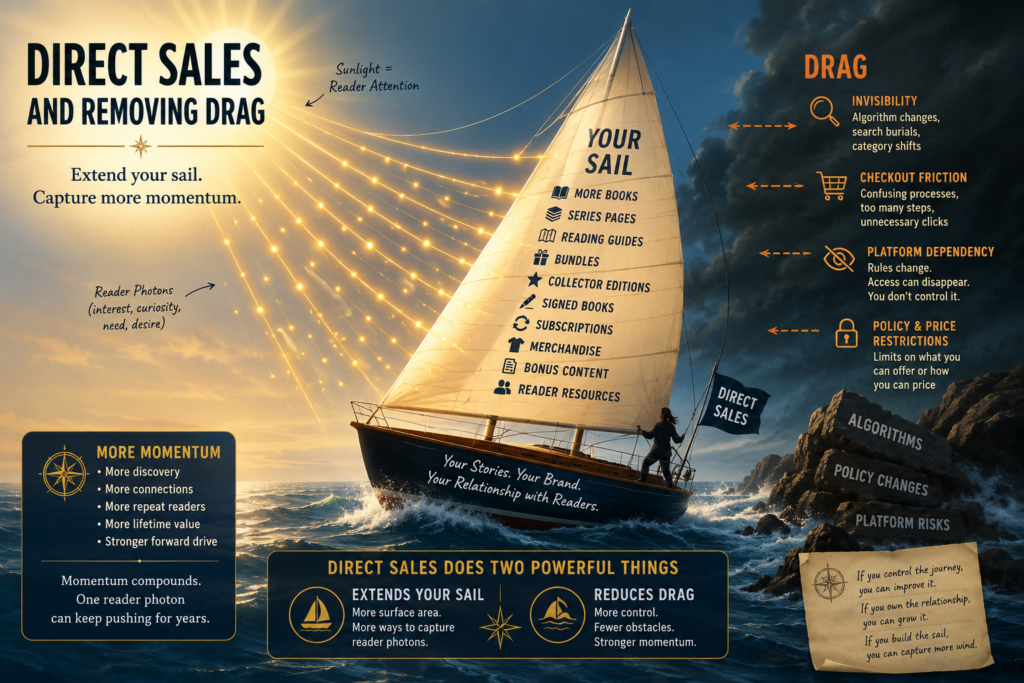
direct sales

Why We Don’t Chase Trends at Stories Rule Press

Trends come and go. One month it’s a trope, a cover style, or a subgenre everyone is chasing; six months later, the industry has already sprinted off after the next shiny object like a Labrador with three tennis balls and no self-control. At Stories Rule Press, we’ve made a different choice. We pay attention to the market, but we don’t build our catalogue around trends. We start with the story—and whether it’s the kind of world a reader can disappear into and want to return to years later.

It’s Not About the Authors. It’s About the Stories.

What if the best story you’ll read next isn’t by the author you already know?

That’s the thinking behind a new direction at Stories Rule Press. Instead of focusing only on individual authors, we’re starting to build collections around something bigger: the kinds of stories readers love to fall into.

If you love thrillers, romance, fantasy, suspense—or any story that keeps you reading long past your bedtime—you may be missing books you’d love simply because you haven’t met the other writers behind them yet.

That’s about to change.

What Will Never Change at Stories Rule Press

Publishing evolves. Tools change. Platforms come and go.
But some things at Stories Rule Press are non-negotiable.

Story comes first. Readers are respected. Authors are partners.

We don’t chase trends, we don’t play games with urgency, and we don’t let algorithms decide what gets published.

We believe in thoughtful growth, careful attention, and direct relationships with the people who actually read the books.

Because if it doesn’t serve the story, the author, and the reader—we don’t do it.

Trad vs Indie in 2026, Part III

Most authors aren’t confused about how traditional and indie publishing work. They’re confused because they’re emotionally attached to what they want those systems to be. In 2026, choosing between trad, indie, or anything resembling “hybrid” isn’t about legitimacy or dreams of a writing career. It’s about understanding which system you’re willing to depend on — corporations behaving well, or yourself. This is the part nobody says out loud.

Trad vs Indie in 2026, Part II

If Part I was the brutal, unsentimental comparison of trad vs indie — advantages, disadvantages, and the cold math of each — then Part II shifts gears completely. Part II dives into what modern indie publishing actually looks like in 2026, because most writers still imagine the 2013 version: KU gold rushes, cheap ads, write-to-market hamster wheels, and algorithmic rituals. That world is gone. Today’s indie career is a full business model built on direct sales, diversified income, long-tail backlist revenue, platform resilience, and storytelling that can’t be replicated by AI. If you don’t understand this version of indie, you can’t choose your publishing path intelligently — and Part II lays it out without sentimentality, delusion, or nostalgia.

When Bookstores Shrink Their Shelves (Even the Digital Ones)

Barnes & Noble has begun quietly removing books from its digital shelves — not because readers don’t want them, but because the retailer wants a “cleaner,” more curated catalog. Overnight, titles vanish. Algorithms shift. Indie books get harder to find.

It’s the same old pattern: as big platforms age, they tighten the gates. The long tail shrinks. Choice narrows. And readers lose access to entire backlists, series, and genres without even realizing it’s happening.

The good news? You’re not trapped in anyone’s walled garden. Buying direct from authors keeps your books permanent, DRM-free, and untouched by corporate inventory purges — no disappearing titles, no algorithmic roulette.

A Few Good Things Are About to Happen

SRP has been quietly building behind the scenes, and now we’re opening the doors a little wider. In this first official post on the new SRP blog, Mark lays out what’s coming: a cleaner store experience, a proper SRP Starter Library, the debut of erotica author Morgan Pearce, more behind-the-scenes content on Substack and YouTube, smarter Kickstarters, and a renewed focus on genuine community over algorithm-chasing. It’s a glimpse of the SRP we’ve been working toward—and the one we’re excited to share.

Review of The Artisan Author by Johnny B. Truant

“At its heart, this book offers a liberating proposal: don’t play the game as it’s currently defined. Walk away from algorithm worship, punishing release schedules, and the grind of selling at 99 cents to churn-hungry subscription readers. Instead, write what you want to write, at the pace that suits you, and charge a fair price for your work.”

Shopping Basket
Scroll to Top