

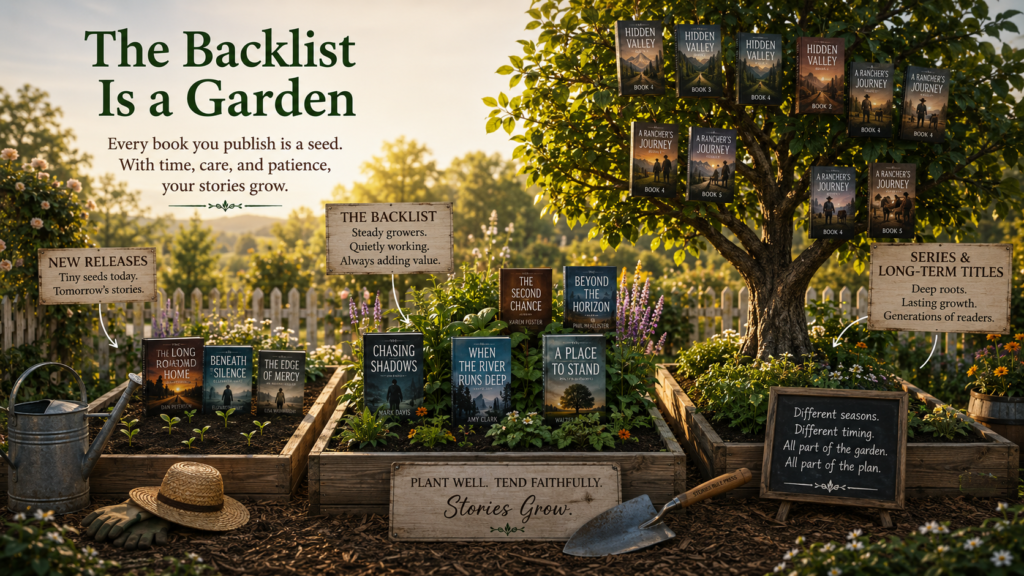
Spend enough time around authors and you’ll hear a lot of discussion about launches.
- Launch week.
- Launch teams.
- Launch strategies.
- Launch numbers.
It’s understandable. A new book is exciting. You’ve spent months, sometimes years, bringing it into existence. Naturally, you want readers to discover it. But one of the biggest shifts that happens when you move from being an author to being a publisher is realizing that books aren’t just products. They’re plants.
Stay with me.
When you plant a garden, you don’t expect everything to grow at the same speed. Some crops sprout almost immediately. Others take weeks before you see anything at all.
Some produce heavily for a short season. Others keep producing all summer. And a few take years before they become what they’re meant to be.
Books are remarkably similar. Every publisher dreams of releasing a title that takes off immediately. Sometimes that happens. A book finds its audience right away and starts generating sales from the moment it appears. More often, though, books have their own timetable.
We’ve seen books at Stories Rule Press sell steadily for years. We’ve seen older titles suddenly find new readers because another book in the series gained attention. We’ve seen books that appeared quiet at first eventually become some of our strongest performers. The point is that a book’s value isn’t determined by what happens during launch week.
Or launch month. Or even launch year.
A healthy publishing business isn’t built on a single bestseller. It’s built on a backlist. One book becomes ten. Ten become fifty. Fifty become hundreds.
Each title contributes something. Each attracts different readers. Each creates opportunities for readers to discover other books in the catalogue.
That’s why publishers think differently than authors often do. A publisher isn’t asking, “How is this book performing today?” A publisher is asking, “Where will this book be five years from now?” Or ten.
The answer is often surprising.
Some of the strongest assets in any publishing company are books that have been quietly doing their job for years. They continue attracting readers, generating income, and introducing people to an author’s work long after the excitement of launch day has faded.
Gardens aren’t built in a weekend. Neither are publishing companies. Both require patience. Both require tending. And both reward those willing to think beyond the current season.
So the next time you hear someone talk about a book launch as though it determines the entire future of a title, remember this: A launch is planting day.
The harvest comes later.
Speaking of gardens, Mark Posey’s new Substack serial, The Summer Garden, is now underway. While our books may be made of paper and pixels rather than soil and compost, the idea is much the same: plant something worthwhile, tend it carefully, and see what grows.
You can read the story for free on Substack, with a new episode appearing every Sunday.