

From the Productive Indie Fiction Writer:
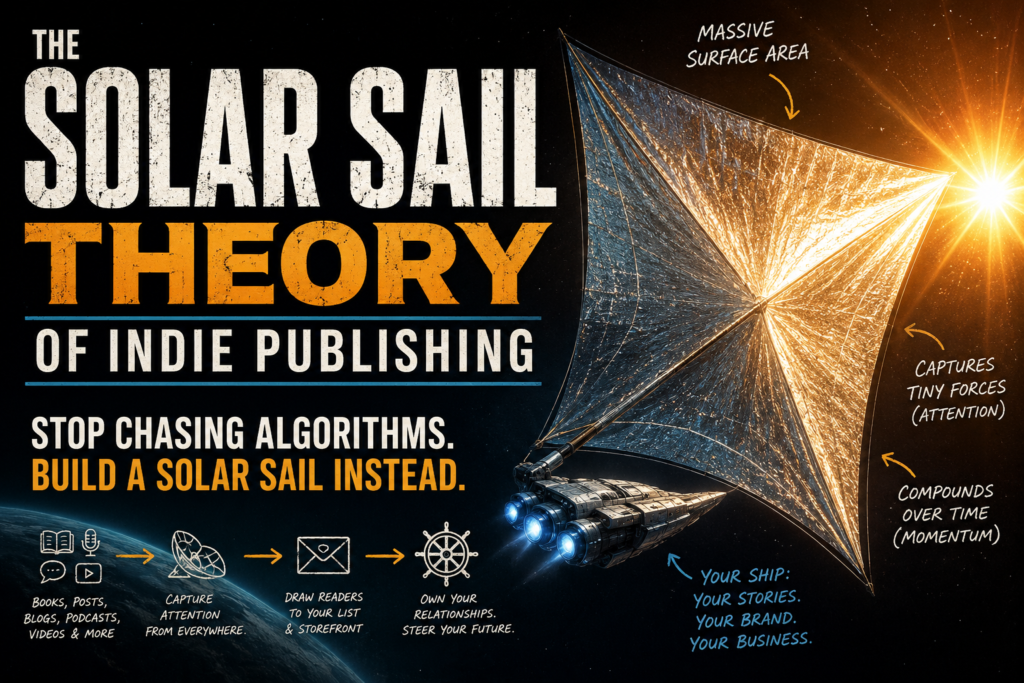
The Solar Sail Theory of Indie Publishing
Stop Chasing Algorithms. Build a Solar Sail Instead.
Daily sales are sinking. Page reads are becoming less predictable. Organic reach on social media is collapsing has collapsed.
Readers download ten thousand free books and never buy book two. AI-generated sludge is flooding storefronts and content platforms by the truckload…every hour.
Retailers keep tightening control over discoverability while giving authors less visibility and less leverage in return.
Meanwhile, Barnes & Noble has made it abundantly clear that indie authors are, at best, tolerated guests in their ecosystem. Amazon keeps squeezing margins, visibility, ads, and competition harder every year.
Search engines are increasingly polluted with AI spam and low-quality aggregation.
There are no clear paths to take that will deliver steady sales. There never were guarantees, but these days, there are no longer any strategies that deliver predictable results for most authors.
We keep following our noses, hoping that this turn will deliver us to where we want to be with our careers and businesses.
The one overlying theme of advice we’re given these days, from experts and other industry gurus, the books we read, the blogs and podcasts we follow, is more.
Write more books. Write them faster. Do more marketing. More social media. Distribute into more places; every nook and cranny thinkable, where you can exchange eBooks for money, and sometimes, just for “exposure” – a trad publishing term that seems to be creeping back into indie parlance. Afterall, giving away freebie first-in-series books is just another form of exposure, isn’t it? And oh my, the megatsunami of free books is terrorizing!
Do more of everything. Do everything; all at once and now. Use Patreon, run Kickstarters, attend live markets, hand sell books, create luxury editions, be on Substack; but be a good Substack citizen while you’re there. Book Tok is non-negotiable (according to the experts), social media essential, email lists problematic, and if you’re not publishing in four different formats and six different languages, you’re being left behind.
And through all of it, indie authors are expected to somehow keep dancing harder for the algorithm: Post more. Engage more. Spend more. Publish faster. Run more ads. Optimize harder.
In the meantime, the platforms that deliver our revenue are deliberately changing underneath us; they don’t care about us, so shifting their store structure so that all our URLs across our entire catalogue break overnight doesn’t phase them.
The old model, what we had of one, is breaking down. There was always guess work involved in being successful as an indie author, but there were guiderails and best practices that we all shared with each other, that kept us moving forward.
Not anymore.
Or maybe more accurately, the old model was never stable in the first place. It only looked stable while the platforms were still in their growth phases and willing to hand out visibility cheaply. That era has ended.
Now that enshittification has set in on every platform and service we use, we have to find a different path.
We need to find a path built around resilience instead of platform dependence. Around discoverability instead of virality. Around ownership instead of tenancy.
We need to stop thinking like rocket launches. (There’s a reason a new release is called a “launch”.)
Instead of thinking about launches and breakthroughs and best seller lists, we can build a solar sail instead.
What Is a Solar Sail?
A solar sail is a real form of spacecraft propulsion. Science fiction readers and authors will know exactly what I’m talking about, but let me explain.
Actually, let me give you a visual shortcut, first. There are a couple of YouTube videos that explain the science here and here; but don’t be fooled by the gee-whiz, this is so new tone; solar sail theory has been around for a very long time. The earliest classic SF writers such as Heinlein and Asimov used them in their fiction, among others.
Unlike conventional rockets, solar sails don’t rely on huge fuel reserves or explosive thrust the way a traditional rocket does. Instead, they use an enormous reflective sail that captures the tiny pressure exerted by photons from sunlight.
Individually, these forces are microscopic. But in the vacuum of space, tiny continuous pressure adds up. Over time, the spacecraft accelerates faster and faster, all without carrying massive amounts of fuel. Speeds the fraction of lightspeed are possible (another astronomical term that means “freaking fast.”)
Don’t miss the important part of this theory as it applies to indie authors. A solar sail works because:
- It exposes a massive amount of surface area.
- It continuously captures tiny forces.
- Those tiny forces compound over time.
You don’t earn impetus through explosive power (launches, marketing drives, appearing on Oprah). You pick up speed slowly, through persistence and scale.
The Problem With “Rocket Launch” Publishing
Most authors still treat publishing like a chemical rocket launch. Everything gets concentrated into one enormous burst of effort:
- one launch week
- one ad push
- one preorder campaign
- one social media blitz
- one desperate attempt to “beat the algorithm.”
Then the fuel runs out. The launch stalls. And the author has to drag the entire thing back onto the launch pad and do it all over again six months later.
This approach is exhausting because it depends on constant high-energy bursts inside systems designed to keep creators dependent on them.
You are permanently reacting, permanently feeding algorithms and finding new ways to make them twitch in your direction. You’re permanently trying to win visibility inside someone else’s ecosystem. And increasingly, those ecosystems are hostile to organic reach unless you pay them.
That’s not independence. That’s tenancy.
The Solar Sail Theory of Indie Publishing
The Solar Sail Theory works differently. The theory is simple:
Indie authors build sustainable careers by maximizing discoverable surface area across the internet and in real life, then channeling that attention toward owned reader relationships and direct infrastructure.
In other words: The larger your sail becomes, the more momentum you can capture.
Your goal is no longer to create one giant marketing explosion. Your goal is to spread your presence as widely as possible so that thousands of small discovery moments continuously push readers toward your work.
Not one massive force. Thousands of tiny ones. Over time. Compounding.
What Counts as “Sail Area”?
Your solar sail is every discoverable surface connected to your author ecosystem. That includes:
- books
- series
- wide distribution
- websites
- blogs
- guest blogging
- newsletters (especially those that are publicly published)
- social media accounts (and perhaps the posts, with some qualifications.)
- podcast appearances
- guest articles
- YouTube videos
- serialized fiction
- collaborations
- anthologies
- reader magnets
- storefront pages
- interviews (if they linger online and are discoverable)
In real life, every time you appear in public in your author role is a chance to spread your sail a little farther, with one key qualification: You must find a way to capture the readers you meet at those events, so that you can keep them near. I’ll expand on this in a future post. For now, just keep that in mind as we approach conference season and the frantic blooming of markets, fairs and pop-ups now summer is approaching
Most of these things will not individually produce huge sales. That’s the first thing authors misunderstand about solar sail theory. A podcast interview might sell three books or none at all (not this week and maybe not ever). A blog post might bring in five subscribers.
And yet all of it matters because the point is not immediate conversion. The point is expanding the size of the sail. Every piece of discoverable surface area increases the probability that readers encounter you somewhere, someday, through some path you cannot predict in advance.
One blog post gets indexed by Google. One podcast gets recommended six months later. One Pinterest pin survives the heat death of the universe. One Reddit comment accidentally sends readers your way. One article gets linked in a forum thread three years from now.
Most discovery online is fragmented, chaotic, and cumulative. The authors who survive are the ones who build enough surface area to capture those drifting currents of attention continuously over time.
The sail captures photons of attention, and then…
Expanding your solar sail is a career-length activity. But even with a small sail in place, you’ll get a trickle of readers pinging against the sail. Your task, then, is to draw them to your ship.
In most cases (just about everyone, actually), that ship is your website, which may also be your direct sales store and your blogging platform.
Once the reader reaches your site, you structure everything on the site to gently coax the reader to sign up for your email list.
You capture them.
This allows you to build up relationships with your readers via email newsletters, direct emails and in whatever way you might communicate directly with them (I have dedicated Discord servers, for example).
Email is the engine. And I know you’ve been hearing that for a decade, but there’s a reason why everyone talks about email like it’s the Holy Grail.
It works.
____
That’s the very basic solar sail theory. Once you understand it, the theory provides some interesting side benefits.
Solar Sail Theory simplifies business decisions.
Let me give you an example. Blogging.
Indie authors and the indie industry in general runs hot and cold over blogging. Traditional publishing seems to have dropped it like a hot potato. Some swear by blogging (Anne R. Allen), while others firmly believe it is a complete waste of time (Jane Friedman) because the ROI isn’t worth it.
Blogging is usually dismissed because it doesn’t directly sell large quantities of books. And honestly? That criticism is partly true. Most blog posts are not direct sales machines. But that completely misses the point.
Blogging matters because it expands your sail. Every useful article you publish becomes:
- searchable surface area
- authority signaling
- discoverable content
- ecosystem expansion
- reader trust
- another pathway into your world.
A blog post written today is still discoverable years from now. I know this in my bones because I’ve been blogging on and off (mostly on) for fifteen years. The search engine crawlers, and now AI search agents, will find a post in my archives, and suddenly, I’m getting twenty or thirty hits a day on a post I wrote weeks or even years ago.
Multiply that effect by two or three other older posts and you’ve suddenly got some pretty decent traffic to your site.
Not every visitor is going to sign up to your newsletter. And not everyone who signs up will do it that day: but they’ve seen your name (and your book covers in the sidebar). It’s a ping on their sub-conscious. A few pings later, they might end up back at your site and this time they might buy a book, or download a free one, or sign up for your email list.
Just like real solar sails, you need a lot of reader-photons pinging against the sail to deliver forward motion.
But blog posts stay where they are for years. They’re discoverable. They’re extending your sail.
And this is why solar sail theory helps you prioritize your strategies and marketing.
If you find yourself wondering, should I blog? – a couple of minutes of fitting the idea up against the criteria for extending your solar sail says yes, blogging is so worth it. Not because blogging instantly sell books, but because it increases sail area.
You can apply solar sail theory to everything you do; you’ll quickly begin to understand where the useless time-sinks in your day exist.
Social media posts disappear into the murky depths of algorithm-land almost overnight on some platforms, but your social media account is always there, and it has a link back to your site. So while you shouldn’t spend hundreds of hours trying to increase your likes and follows, having the accounts there and enough posts to make them viable and visible does increase your sail.
See how the theory cuts through a lot of confusing and conflicting advise?
More Books = More Sail
This is also why it is important to have a stable and consistent writing practice, which produces and releases books steadily. Every new book expands your discoverable surface area. Each title creates:
- another retailer entry point
- another keyword cluster
- another recommendation possibility
- another algorithmic pathway
- another series hook
- another binge opportunity
Later books in a series not only extend that series and get it closer to finished (which also draws more readers), but it is a page on Amazon, a page on Barnes & Noble, Kobo, Google Play Books, your website, Goodreads, and any site that consistently catalogues new book releases. And that’s with just one release.
This is one of the reasons why fast writers seem to be (in general) successful. It isn’t the rapid release of titles itself that is magically drawing readers. It’s the hugely expanded solar sail that many titles will build.
Fast(er) writers deploy more sail. They create more opportunities for discovery, read-through, compounding visibility and so on. And the market increasingly rewards accumulated surface area.
Visibility Alone Is Not Enough
I’ve mentioned this once already. I want to draw your attention back to this point, because it’s critical.
A solar sail without a ship attached is useless.
Visibility is not the end goal. Capture is. The purpose of your sail is to draw readers toward infrastructure you actually control.
That means:
- your website
- your email list
- your direct customer relationships
- your community
Social media is not your business. Retailers are not your business. Algorithms are not your business. Those are merely the external currents of reader-photon streams you are attempting to harvest.
Your actual business is the relationship between you and your readers. That relationship will become dramatically more important as the platforms continue to decay.
Your Email List Is the Engine Room
This is why email lists matter so much. An email list is not just a marketing tool. It is stored momentum. Every subscriber represents retained propulsion for your career.
And yes, size matters. A larger email list creates larger pushes on the sail, more momentum, stability and resilience against platform volatility.
It gives you independence from algorithms.
Authors sometimes obsess over open rates while ignoring scale, but scale changes everything. A 50,000-reader list can absorb fluctuations that would devastate a 500-reader list.
The larger your owned audience becomes, the less vulnerable you are to the decisions of external platforms. This is especially important in an era where algorithmic reach can disappear overnight.
Your email list is one of the few discoverability systems you truly own. And ownership matters now more than ever.
Email engineering and scale are so important that I will be devoting a separate post to this, next week.
Direct Sales Remove Drag
Retailers are useful. They provide sail surface area. But they are also limitations, as we’ve all become painfully aware of in the last few years.
Every external platform introduces friction, dependency, and vulnerability. They control visibility, discoverability, customer access, merchandising limitations, recommendations and most importantly, algorithmic reach.
You are building on rented land (and I know you know that). That doesn’t mean abandoning retailers, though. Far from it. Wide distribution itself increases sail area. But over time, indie authors need increasing levels of direct infrastructure:
- direct stores
- crowdfunding
- subscriptions
- memberships
- direct launches
- reader communities
Direct customer relationships reduce drag. A ship fully dependent on retailer algorithms is sailing with anchors attached. The more direct your relationship with readers becomes, the more efficiently momentum compounds. They see every message you put out there. They can find and access every book you’ve published.
Your site doesn’t redirect them to a best seller list of other authors’ books. Have you tried to find a complete catalogue of any one category on Amazon lately? It’s gone. You can only navigate to the best seller lists. Readers simply cannot trip over your book or you if you’re not in the top 100 of your category, or if they don’t have a direct link to your book. Your book will only surface occasionally if the reader happens to put in a search term that matches your book.
The Future Belongs to Authors with Surface Area
The internet is entering a period of fragmentation. Search is changing. Social media is changing. Retail discovery is changing. AI content saturation is changing everything.
In that environment, discoverability becomes less about dominating one platform and more about existing everywhere readers might encounter you. That requires a different mindset.
There’s little reason to obsess about virality, hacks, launch spikes and algorithm chasing. Instead, you can focus upon (far less stressful) strategies like persistence, distribution, discoverability, ownership and accumulated surface area.
The indie authors who survive the next decade will not necessarily be the loudest. They’ll be the ones with the largest sails. The ones who spread their discoverability across the widest possible area. The ones who build systems instead of chasing spikes.
The ones who turn readers into direct relationships rather than temporary transactions.
The ones who continue expanding their surface area inch by inch, year after year, while everyone else burns themselves out trying to manufacture another rocket launch.
You do not build a sustainable indie career through one explosive burst of visibility. You build it by deploying a sail large enough to catch thousands of small forces over time.
And once enough momentum accumulates? The ship starts moving fast.
.

Tracy Cooper-Posey
SRP Author and owner of The Productive Indie Fiction Writer