

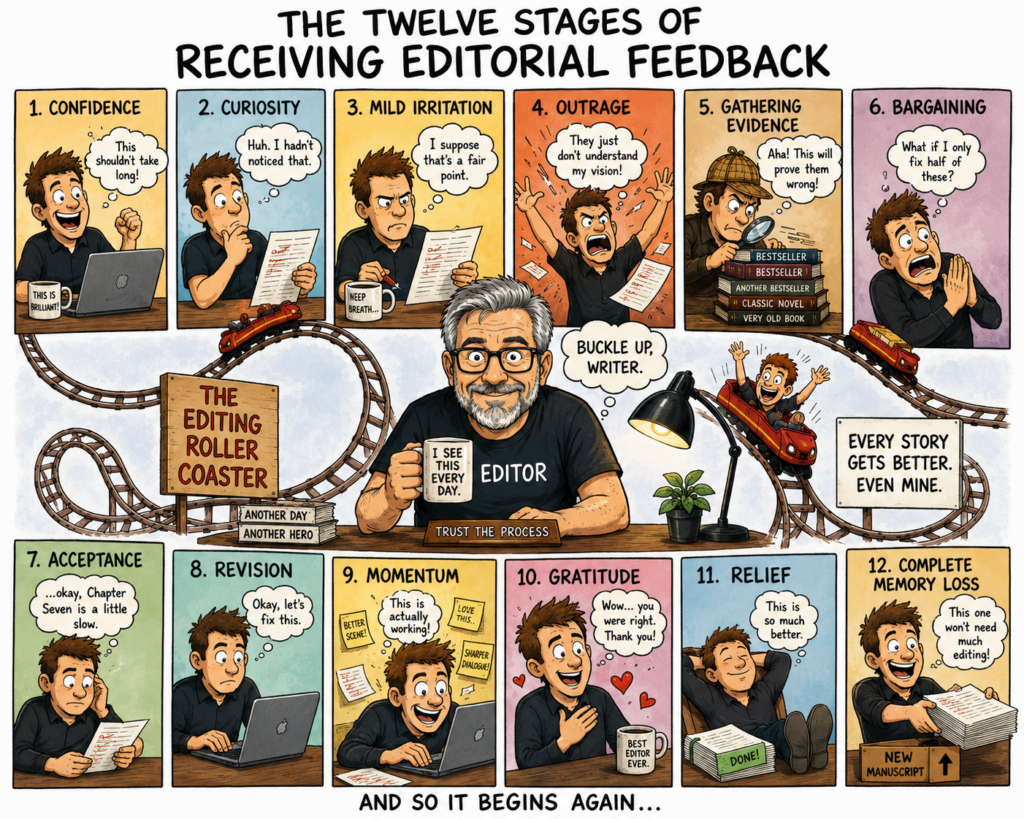
From the SRP Editor site:
Sooner or later, every writer sends a manuscript to an editor. Some do it with quiet confidence, convinced there might be three typos and a missing comma. Others send it with the emotional equivalent of handing over a smoking wreck and saying, “I’m pretty sure it still flies.” Oddly enough, both writers tend to react to editorial feedback in almost exactly the same way.
After years of editing novels, I’ve become convinced there are twelve distinct stages every writer goes through. They don’t always happen in exactly this order, and sometimes writers skip one or two. More often than not, though, they hit every single stage before the manuscript finds its way back to me.
Stage One: Confidence. The manuscript goes off with a cheerful wave and the quiet conviction that it won’t need much work. The writer has read it six times already, after all, and it seems pretty solid. The editor smiles, not because the manuscript is bad, but because every manuscript has room to improve.
Stage Two: Curiosity. The edits arrive, and the writer starts reading. At first it’s almost interesting. “Huh… I hadn’t noticed that.” They make a few changes, nod thoughtfully, and wonder what all the fuss about editing has been.
Stage Three: Mild Irritation. Then the comments keep coming. The writer begins muttering things like, “Well, I suppose that’s a fair point,” while mentally composing a rebuttal the editor will never actually receive. This is perfectly normal. Editors are accustomed to being temporarily unpopular.
Stage Four: Outrage. Eventually comes the moment when the writer is absolutely certain the editor doesn’t understand the story at all. This stage is usually accompanied by pacing, coffee, and declarations that “this is exactly how I intended it.” Experienced editors simply wait. We’ve seen this movie before.
Stage Five: Gathering Evidence. The writer begins pulling favourite novels off the shelf, convinced one of them will contain a chapter that proves the editor completely wrong. Several books later, an uncomfortable realization begins to dawn: the published authors solved the very problem the editor was pointing out.
Stage Six: Bargaining. Now the negotiations begin. “What if I only fix half of these comments?” or “Maybe I can leave Chapter Seven exactly as it is.” This is an understandable impulse, but stories have an annoying habit of refusing to compromise.
Stage Seven: Acceptance. Somewhere along the way, usually after a good night’s sleep, the writer rereads the manuscript and quietly admits that Chapter Seven really is a little slow. This is the turning point. The editor hasn’t won an argument; the story has.
Stage Eight: Revision. Scenes move. Dialogue sharpens. Characters suddenly discover personalities they didn’t have before. Entire chapters disappear without anyone missing them. It’s remarkable how often the manuscript starts feeling more like the story the writer originally imagined.
Stage Nine: Momentum. This is my favourite stage because something wonderful happens. The writer starts fixing problems I never even mentioned. They’ve begun seeing the manuscript through a different lens, and suddenly they’re making improvements because they want to, not because an editor suggested them.
Stage Ten: Gratitude. Eventually comes the email every editor enjoys receiving. It usually says something like, “I hated hearing that at first, but you’re right. The book is much stronger now.” Editors don’t expect thanks, but it’s always appreciated.
Stage Eleven: Relief. The revisions are finished, the manuscript is cleaner, and the writer discovers they aren’t embarrassed by the book anymore. In fact, they’re rather proud of it. That’s exactly where every editor hopes their clients will end up.
Stage Twelve: Complete Memory Loss. About six months later, the next manuscript arrives with a cheerful note that says, “This one shouldn’t need much editing.”
And just like that, the cycle begins again.
The funny thing is that editing isn’t about proving an editor is right or a writer is wrong. It’s simply two people working toward the same goal: making the story the best version of itself. Every manuscript can improve, even those written by professional editors. Mine certainly do.
So, if you’ve just received your editorial letter and you’re somewhere between Mild Irritation and Outrage, don’t worry. Every writer I know—including me—has been there. Give it a day or two, then read the comments again. You may discover your editor wasn’t trying to change your story after all. They were trying to help readers love it as much as you do.
— Mark