

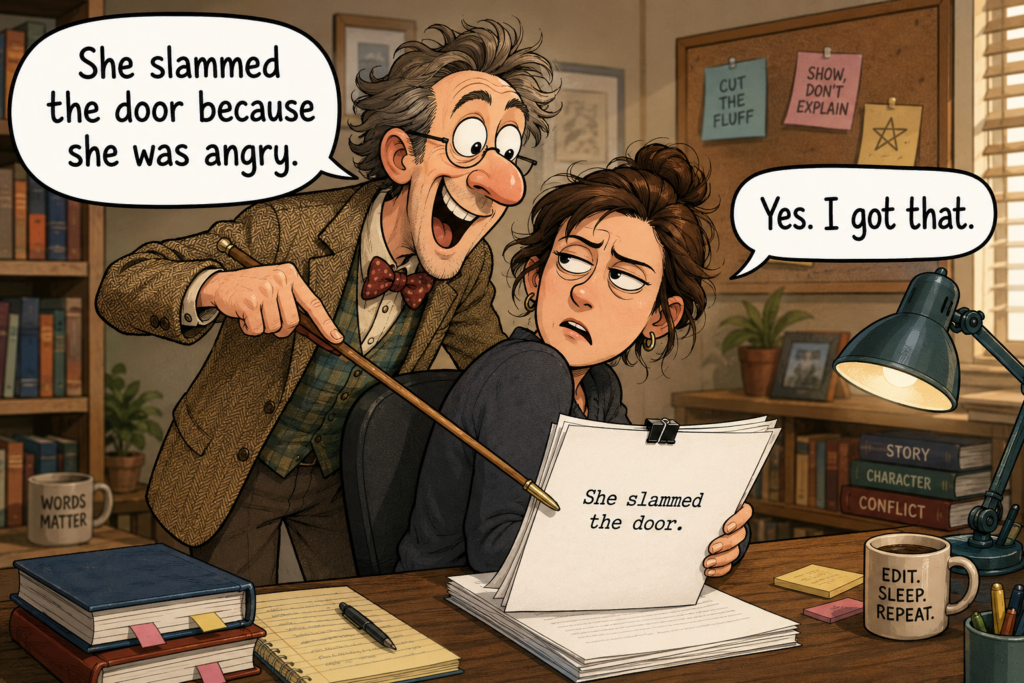
From the SRP Editor site:
Writers are helpful people.
We spend a great deal of time making sure readers understand what is happening, why it is happening and how everyone involved feels about it. Unfortunately, there are times when we become so determined to be helpful that we explain something the reader understood perfectly well the first time.
Consider this:
“I don’t care where you go,” Sarah said, turning away from him. “Just don’t be here when I get back.”
She was angry with him and wanted him to leave.
That second sentence isn’t adding anything. Sarah’s dialogue and action have already made her feelings abundantly clear. Unless she routinely turns away from people and orders them out of the house as an expression of affection, the reader is unlikely to misunderstand.
This is one of the most common things I remove while editing fiction: the sentence that explains the sentence before it.
Writers frequently do this with dialogue. A character says something cutting, and the narration explains that he intended to hurt the other person. Someone refuses to meet another character’s eyes, and we’re told she feels guilty. A man slams the door hard enough to shake the pictures on the wall, followed by the useful information that he is angry.
By that point, the reader isn’t being guided. They’re being escorted across a street they have already crossed.
The habit is understandable. Writers know exactly what a character is feeling, but they can never be entirely certain that the feeling has made it from their imagination onto the page. So they provide the dialogue, the physical reaction and the explanation, just to make sure nothing gets lost along the way.
The problem is that the explanation usually weakens what came before it.
If Sarah tells someone to be gone before she returns, readers get to interpret the moment for themselves. They hear the anger in her words. They see her turn away. They may also detect hurt, disappointment or fear beneath the anger, depending on what has happened earlier in the scene.
Tell them simply that she is angry, and all those other possibilities disappear. The explanation doesn’t deepen the moment. It reduces it. This happens with character decisions as well:
David looked at the unsigned contract, then at the photograph of his daughter beside the telephone. He picked up his pen.
He had decided to accept the offer because he needed the money for his family.
The first paragraph gives us an action and a meaningful detail. It allows the reader to make the connection. The second paragraph arrives afterward and fills out the paperwork.
There are, of course, times when an explanation is necessary. A character’s actions may be deliberately misleading. Their true motivation may contradict what they appear to be doing. The photograph might remind David not of his responsibility to his daughter, but of a promise he made never to become like his own father. In that case, the reader may need additional information because the obvious interpretation is incomplete or wrong.
The question isn’t whether readers should ever be told what something means. The question is whether they have already been shown.
When I encounter one of these explanatory sentences in a manuscript, I usually try reading the passage without it. If the meaning remains clear, the sentence probably isn’t helping. If the scene becomes confusing or loses an important layer, then the explanation may be doing necessary work—or the action and dialogue may need to be strengthened.
This is where trusting the reader and trusting the writing become the same thing. If the scene has done its job, the reader will understand. More importantly, they’ll experience the moment instead of receiving a report about it.
Writers are helpful people. Sometimes the most helpful thing we can do is stop explaining.
— Mark