Indie Publishing

The Easy Way To… (Get Ripped Off)

Everyone’s teaching authors how to spot scammers with lists of red flags and warning signs. But none of that works if your mindset is wrong. Because if part of you still wants the “easy way,” you’ll explain away every clue. Here’s why modern scams work — and the one shift that makes you almost impossible to fool.

What Will Never Change at Stories Rule Press

Publishing evolves. Tools change. Platforms come and go.
But some things at Stories Rule Press are non-negotiable.

Story comes first. Readers are respected. Authors are partners.

We don’t chase trends, we don’t play games with urgency, and we don’t let algorithms decide what gets published.

We believe in thoughtful growth, careful attention, and direct relationships with the people who actually read the books.

Because if it doesn’t serve the story, the author, and the reader—we don’t do it.

Writing While the House Is On Fire

Right now the to-do list is loud. Fulfill a 660%-funded Kickstarter. Edit other writers’ books. Run a publishing company. Market existing titles. Keep upcoming releases on track. And somewhere in there is a quiet little line that says: Write the next book.

That line is always the easiest to slide.

Because it doesn’t yell. It doesn’t send invoices. It doesn’t have shipping deadlines. It just waits — patiently — while everything else feels urgent.

Trad vs Indie in 2026, Part III

Most authors aren’t confused about how traditional and indie publishing work. They’re confused because they’re emotionally attached to what they want those systems to be. In 2026, choosing between trad, indie, or anything resembling “hybrid” isn’t about legitimacy or dreams of a writing career. It’s about understanding which system you’re willing to depend on — corporations behaving well, or yourself. This is the part nobody says out loud.

Cliffhangers

Readers don’t actually hate cliffhangers.
They hate being cheated.

What they’re reacting to isn’t tension or anticipation—it’s a broken promise. An ending that withholds resolution, slices a single story into artificial chunks, or stops mid-thought without delivering what the book itself set up isn’t a cliffhanger at all. It’s a contract breach.

A real cliffhanger resolves the story you promised to tell—and then opens the door to the next problem. It creates momentum, not confusion. When done right, the reader doesn’t feel tricked. They feel hooked.

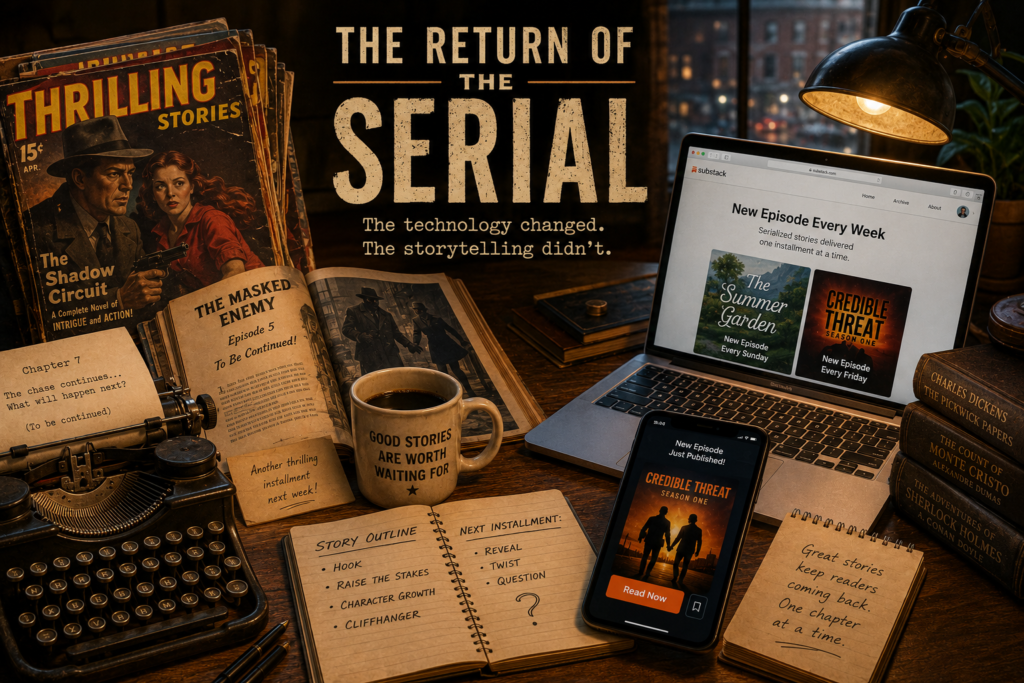
Binge or Drip? The Serial Reading Argument No One Actually Wins

There are two kinds of readers in the world.
The kind who says, “Just one more chapter,” and resurfaces hours later dehydrated and emotionally compromised.
And the kind who prefers the slow burn—one episode a week, time to speculate, time to argue, time to savor.

The internet insists one of these is correct.

They’re wrong.

This isn’t a format war. It’s a control issue—and Credible Threat is about to give both camps exactly what they want.

Trad vs Indie in 2026, Part II

If Part I was the brutal, unsentimental comparison of trad vs indie — advantages, disadvantages, and the cold math of each — then Part II shifts gears completely. Part II dives into what modern indie publishing actually looks like in 2026, because most writers still imagine the 2013 version: KU gold rushes, cheap ads, write-to-market hamster wheels, and algorithmic rituals. That world is gone. Today’s indie career is a full business model built on direct sales, diversified income, long-tail backlist revenue, platform resilience, and storytelling that can’t be replicated by AI. If you don’t understand this version of indie, you can’t choose your publishing path intelligently — and Part II lays it out without sentimentality, delusion, or nostalgia.

A Few Good Things Are About to Happen

SRP has been quietly building behind the scenes, and now we’re opening the doors a little wider. In this first official post on the new SRP blog, Mark lays out what’s coming: a cleaner store experience, a proper SRP Starter Library, the debut of erotica author Morgan Pearce, more behind-the-scenes content on Substack and YouTube, smarter Kickstarters, and a renewed focus on genuine community over algorithm-chasing. It’s a glimpse of the SRP we’ve been working toward—and the one we’re excited to share.

Editing King Arthur (Again): Notes From the Once and Future Hearts Trenches

Editing a thirteen-book Arthurian saga isn’t for the faint of heart. Mark pulls back the curtain on his years in the trenches with Once and Future Hearts—from navigating character continuity and protecting authorial voice to the diplomatic art of asking, “Are you sure, Tracy?” as the finale, Camlann, heads into its early-release Kickstarter celebration.

Trad vs Indie in 2026

Traditional publishing and indie publishing aren’t just two different business models — they’re two different belief systems. Trad authors think they’re building a career as an artist. Indie authors know they’re running a business. In 2026, that mindset divide matters more than ever. With AI flooding the marketplace, platforms deep in enshittification, bookstores shrinking, and rights tied up tighter than a banker’s fist, the only way to make good choices is to understand exactly how each system really works — not how you wish it worked. This is the brutal, unsentimental guide to both paths.

Shopping Basket
Scroll to Top