

From the SRP Editor site:
Most writers enjoy writing. Fewer writers enjoy rewriting.
That’s understandable. Writing a first draft feels creative. It feels like progress. You sit down with a blank page and, by the end of the day, something exists that wasn’t there before.
Rewriting doesn’t always feel that way. You can spend three hours revising a chapter and finish the day with fewer words than you started with. To many writers, that feels like moving backward. In reality, it’s often where the real work begins.
One of the most common misconceptions about writing is that successful authors sit down and produce brilliant prose on the first attempt. Every now and then a story arrives unusually clean, but most books are built the same way houses are built: in stages. First comes the frame. Then the walls. Then the wiring, plumbing, insulation, drywall, paint, and finishing touches. Nobody looks at a framed house and mistakes it for the finished product. Yet many writers expect a first draft to look like a published novel.
The first draft exists to discover the story. Revision exists to tell it well.
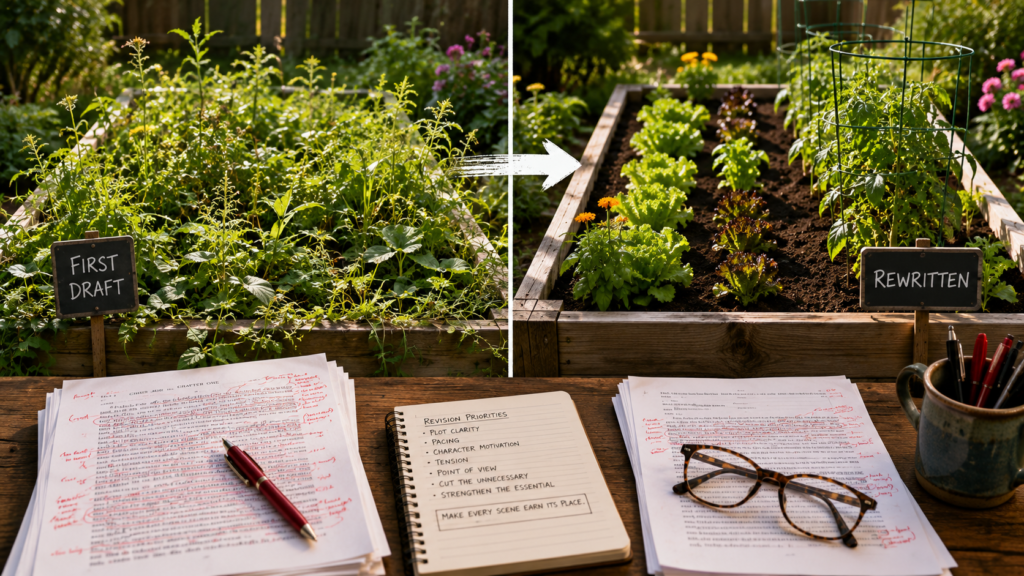
Lately, I’ve been spending a great deal of time in the garden. Like many gardeners, I’ve discovered that weeds don’t care about your schedule. Leave a bed unattended for a week or two and nature happily begins making decisions on your behalf. The vegetables are still there. The garden is still healthy. But the weeds begin competing for sunlight, water, nutrients, and space.
Manuscripts behave much the same way.
The first draft often contains wonderful ideas surrounded by things that don’t belong. Scenes that seemed important but aren’t. Conversations that repeat information. Descriptions that wander. Characters who take too long to reach the point. Plot threads that looked promising until the rest of the story revealed otherwise. None of these elements are signs of failure. They’re signs that the writer was exploring the story.
Revision is the process of deciding what deserves to remain. In that sense, editing often resembles weeding more than writing. The goal isn’t to destroy the garden. The goal is to remove what prevents the garden from thriving. Every unnecessary scene removed gives more room for the important scenes to breathe. Every redundant paragraph cut strengthens the paragraphs that remain. Every confusing sentence clarified helps the reader move through the story with less friction.
This is one reason experienced writers tend to become less attached to word count over time. New writers often celebrate adding words. Veteran writers learn to celebrate removing the right ones. The question isn’t whether a manuscript is longer or shorter after revision. The question is whether it works better.
As an editor, I’ve seen manuscripts improve dramatically through thoughtful revision. Not because the author changed the story entirely, but because they learned to recognize the difference between what they intended to say and what actually appeared on the page. Those are rarely identical. Revision closes the gap.
The good news is that rewriting becomes easier once you stop viewing it as punishment for getting the first draft wrong. That’s never what revision is. A first draft isn’t a failed book. It’s the raw material from which the finished book will be built.
The writers who understand this tend to improve faster than those who don’t. They stop chasing perfection in the first draft and start focusing on progress. They accept that writing and rewriting are not competing activities. They are two halves of the same process.
The first draft grows the garden. The rewrite is where you decide what deserves to bloom.
— Mark