writing advice

The Comfortable Manuscript Problem

There’s a point in many manuscripts where the story quietly pulls back. The conflict softens, the dialogue becomes safer, and characters make the reasonable choice instead of the revealing one. The result is a manuscript that is technically good—but often forgettable. The moments readers remember are rarely the comfortable ones.

The #1 Problem I See in Manuscripts Right Now

The most common problem I see in manuscripts right now isn’t bad prose or weak dialogue. It’s stories where the protagonist could simply walk away—and nothing meaningful would happen. If your character can shrug and go home, they probably should. So why don’t they?

Safe Writing Is Dangerous Now. Here’s What to Write Instead.

Readers do not know what they want until they see it. They cannot ask for the strange combination, the odd obsession, or the idea that should not work but somehow does. That is your advantage. The books that stand out now will not be the safest ones. They will be the ones only you could have written.

Why Stand By Me Still Works (When So Many Stories Don’t)

Why does Stand By Me still hit forty years later when so many stories vanish almost as soon as the credits roll? Because it isn’t built on spectacle or plot twists. It’s built on emotional truth. Four boys, one long walk, and a story that trusts us to care about the people more than the destination. That’s a rare thing. And maybe that’s why it still works.

Why Most Manuscripts Fail in Chapter One

Most manuscripts don’t fail because the author lacks talent—they fail because Chapter One doesn’t do its job. Chapter One isn’t a warm-up, a weather report, or a backstory dump. It’s a promise to the reader about what kind of story they’re about to experience. If nothing is off-balance, nothing is at risk, and nothing is changing, the reader is left asking the most dangerous question in fiction: Why am I here?

Your Editor Can’t Fix This (And You’re Paying Them To Try)

Writers sometimes send manuscripts to an editor hoping the edit will “make it work.” But when the foundation of the story is cracked — weak character arcs, passive scenes, or conflict happening offstage — no amount of line editing can fix it. Editing refines what already works; it doesn’t rebuild the structure. Knowing the difference can save writers money, frustration, and a lot of misplaced hope.

Five Things Editors Wish Writers Knew

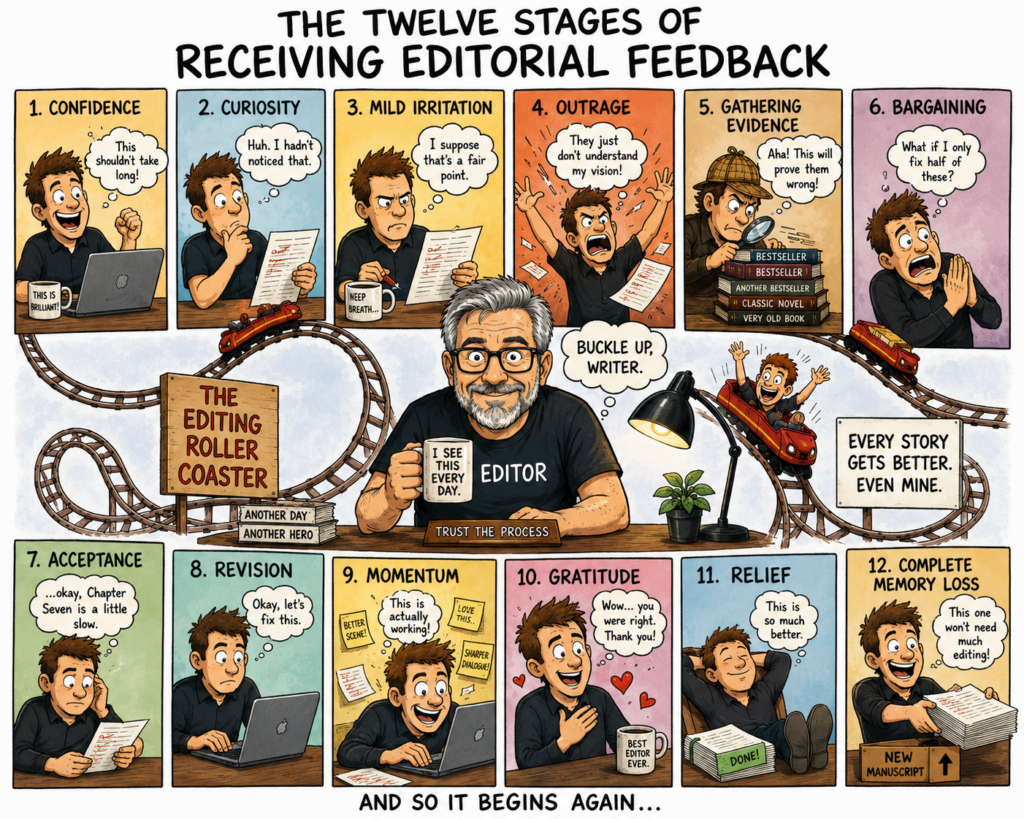
After you’ve been editing fiction for a while, patterns emerge — not in the stories, but in the expectations writers bring to the process. Editing isn’t about fixing broken books or policing commas. It’s about helping a manuscript work the way the author intended: with clarity, emotional logic, and structural strength. Here are five things editors quietly wish every writer understood before the red pen ever comes out.

Cliffhangers

Readers don’t actually hate cliffhangers.
They hate being cheated.

What they’re reacting to isn’t tension or anticipation—it’s a broken promise. An ending that withholds resolution, slices a single story into artificial chunks, or stops mid-thought without delivering what the book itself set up isn’t a cliffhanger at all. It’s a contract breach.

A real cliffhanger resolves the story you promised to tell—and then opens the door to the next problem. It creates momentum, not confusion. When done right, the reader doesn’t feel tricked. They feel hooked.

Anyone Quoting Black-and-White “Rules” About Writing Is Full of Crap

If someone is handing you absolute, black-and-white “rules” about writing, they’re full of crap.
Most of those commandments started life as reasonable cautions… before nuance died somewhere between a conference panel and a poorly edited podcast rant.

Real editors don’t enforce rules.
Real editors ask one question: Is this working for this story, this audience, this moment?

Follow every so-called rule perfectly and you won’t write a great book — you’ll just write a technically correct, emotionally flat one.
Rules can stop you from making mistakes.
They cannot help you make choices.
And writing is nothing but choices.

Shopping Basket
Scroll to Top