

From SRP author Cameron Cooper:
It’s a new year, and the speculative fiction media machine is revving its engines.
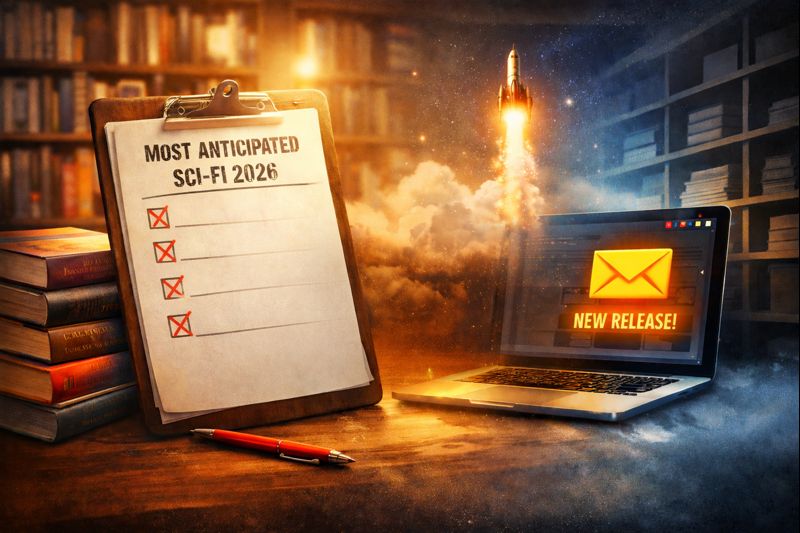
You’ve seen them—those breathless “Most Anticipated Sci‑Fi of 2026” lists, (and yes, I said sci-fi—because that’s how trad publishing and casual readers usually label it. Old-school fans and writers know the term is SF, or science fiction, and they tend to grimace through their teeth if they have to say sci-fi out loud. Ahem).
Anyway, the “Most Anticipated” lists are packed with upcoming titles from the usual suspects: Tor, Orbit, Del Rey, and the many boutique imprints clustered around the Big Five (or Four, depending on who’s acquired whom this week). It’s a wave of hype, and readers love it. There’s something energizing about peeking ahead at what the year might hold.
At the moment, there are a lot of those lists floating around. And if you’re paying attention, you might notice something missing.
Well—two things, actually.
The first is sequels and later books in series. Everything on these lists is usually a standalone title, or maybe the first in a new series. Only massive bestselling authors in SF tend to get long series runs through traditional publishing.
The second thing missing? Indie author titles. Not a single one.
And the reason has nothing to do with quality.
Indie Presses ≠ Indie Authors
Let’s untangle a common confusion up front.
You might see books from independent presses on those “anticipated” lists—publishers like Angry Robot, Tachyon, or Solaris. These are technically indie: they’re not owned by one of the Big Five, and they often champion unusual or niche titles. But the authors publishing with them are still traditionally published. They’re paid advances and royalties. They go through editorial pipelines and publicity schedules. They’re part of the system.
Indie authors, by contrast, are their own publishers.
Some have personal imprints (like I do). Some keep it under their own name. But the business model is entirely different. Indie authors own their rights and revenue, publish on their own schedules, maintain direct relationships with readers, and make the creative and commercial decisions themselves. They pay for the release of their books themselves.
So while a few indie press titles might slip into the media cycle, indie author books almost never do.
(I wanted to say a flat “never,” but if I didn’t qualify it, I just know a list will pop up somewhere with an indie author title on it, just to prove me wrong. Because… hubris.)
The Hype Machine Has a Long Lead Time
Traditional publishing thrives on anticipation. Books are acquired years in advance. Publicity plans start rolling 12–18 months before release. Review copies go out. Cover reveals are teased. There are listicles and industry features and strategic convention appearances.
Indie authors don’t do any of that. Or more accurately—we don’t need to.
Our production schedules are agile. We’re not beholden to seasonal catalogs or sales targets. We publish when the book is ready. And often, that means a book is announced and released in a tight window—weeks or even days apart.
That’s not a flaw. It’s a feature. We’re not trying to build pre‑release buzz. We’re trying to tell great stories and get them into your hands as soon as they’re ready.
Readers Have to Move in the Author’s Orbit
Here’s the important part. If you’re the kind of reader who finds an author you like and then looks for everything else they’ve written, congratulations. You’re doing it right.
But if that author is indie, and you stop there, you might never know when they publish again. Because indie authors don’t have bookstore placement or advance press coverage to remind you. We rely on reader connection, not algorithmic distribution.
To stay in the loop, you need to move into the author’s orbit.
Join their newsletter. Follow their blog or RSS feed. Follow them on social media if they’re active there. Use retailer follow tools when available.
And if you don’t see a clear news feed? Ask. Most indie authors are accessible. A quick message can get you connected, and might even prompt them to set up better reader channels.
Indie authors don’t shout through megaphones. We don’t have store placement or launch parties. We speak directly to readers. And if you want to catch the next book, you need to be tuned to our signal.
Once you’re tuned in, though, the news will come directly to you. You won’t have to rely on “Most Anticipated” lists to know what’s coming next.
A Different Kind of Storytelling
There’s one more reason you don’t see indie titles on most‑anticipated lists: they’re playing a different game entirely.
Indie author books are written for readers, not for marketing teams. They’re part of long, immersive series that aren’t cut short by sales forecasts. They’re free to mix genres, twist tropes, and go strange without editorial interference. They’re released on timelines that prioritize story momentum, not quarterly spreadsheets.
Indie authors are writing to entertain, more often than not. They tell stories.
If you’ve ever binged a space opera that defied expectation, or stuck with a series that got better with every book, there’s a good chance you were reading an indie author, whether you knew it or not.
And that’s another reason those “anticipated” lists don’t include sequels or series titles. Because they’re only drawing from traditional publishers—and traditional publishing rarely commits to finishing a full series. Their practice of “printing to net” just about guarantees that many series never make it past book one.
Traditional publishing instead throws out a lot of first books. They’re not even doing it to see what sticks. They don’t care about series. In fact, they don’t like them. (And trad authors learn quickly to never speak in terms of series, because it makes their publisher itchy. If they’re writing what they hope is book one of a longer arc, they make very sure to never say that aloud.)
Traditional publishers care about squeezing maximum profit out of this book, right now. That’s why you get all the long-tail pre-publication buzz. The hype. The glitzy rollouts. The “most anticipated” lists blaring at you from every direction.
What Should You Do?
If you want to know what’s really coming in science fiction this year, don’t just read the lists. Read the authors.
Broaden your net. Acquire books from everywhere. Try stories with compelling covers or enticing blurbs. Find books through BookFunnel, StoryOrigin, or through direct author websites. Explore alternative retail platforms—not every book is available everywhere.
Try widely. And when one bites—when a story hooks you—acquire that author.
Subscribe. Join their orbit. Stay in touch. Because in the indie world, the stories don’t end. They evolve. They surprise. And they often arrive quietly, but with gravity.
The most exciting SF you read in 2026 might never show up on a media roundup.
It might just show up in your inbox.

Cameron Cooper
SRP Author
Check Cam’s books here on Stories Rule Press.